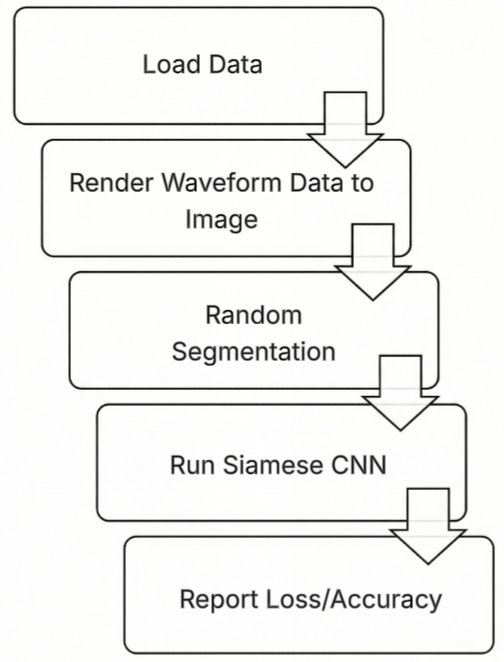
Earthquakes are sudden releases of energy in the Earth's crust that generate seismic waves recorded as time‐series signals called seismograms. Earthquake analysis depends on interpreting the temporal structure of seismic phases, yet many machine-learning approaches require large manually labeled datasets that are difficult to obtain at scale. To address this, we propose a self-supervised framework that learns waveform continuity and ordering cues without human annotations. Our approach consists of two steps: preprocessing and model training. In preprocessing, each one-dimensional waveform is converted into a standardized waveform image and partitioned into a fixed number of consecutive segments with small gaps to simulate missing observations and create non-contiguous inputs. In model training, these segments are randomly shuffled and used to train a Siamese convolutional neural network to predict the shuffled order through a permutation-classification objective, where pseudo-labels are generated automatically from the applied shuffle. We evaluate the framework across multiple segment settings and summarize its performance trends as task difficulty increases. Overall, this study demonstrates that permutation-based self-supervision can enable learning useful waveform structure from unlabeled data, and it suggests a practical direction for developing phase-aware representations that can support future seismic analysis when labeled data are limited.