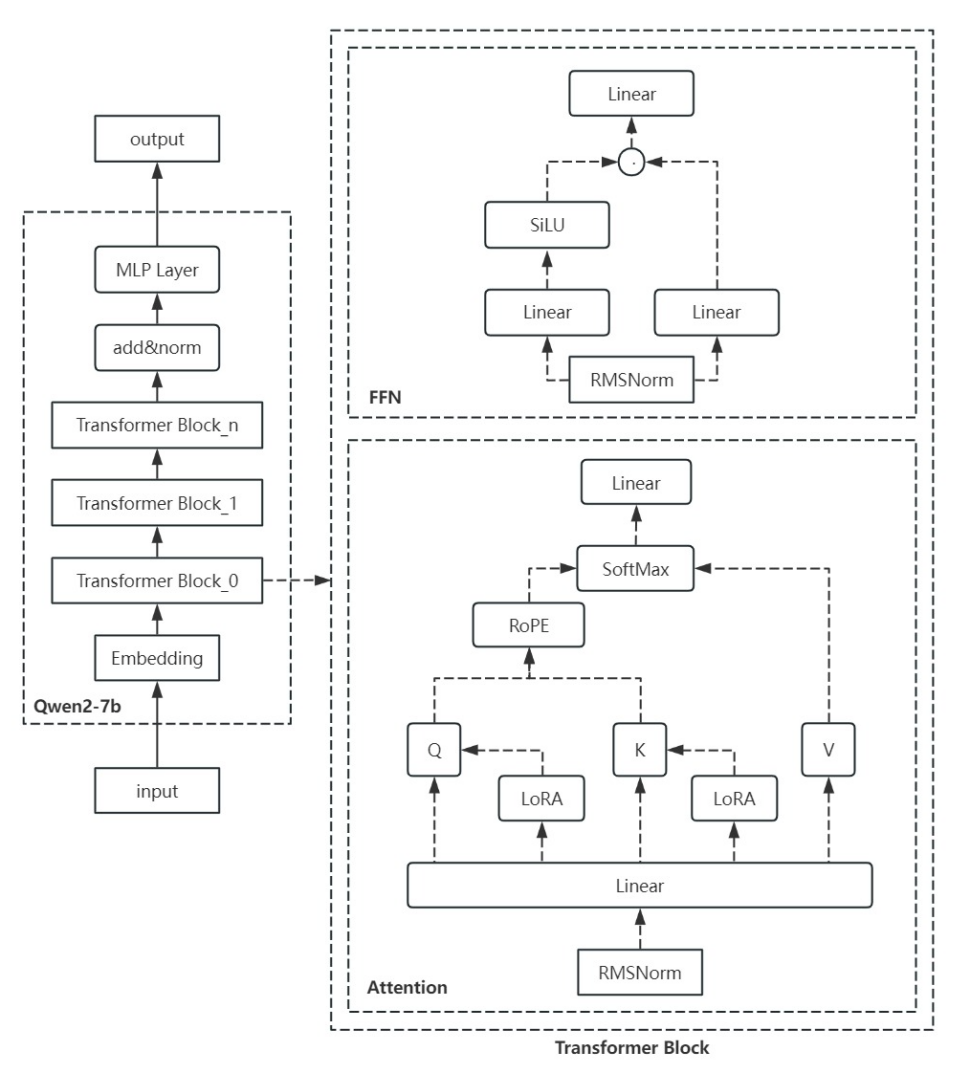
With the rapid development of the Internet and social media, the multidimensional subjective sentiments embedded in massive volumes of user-generated content have become a critical data foundation for business intelligence, public opinion monitoring, and public decision-making, thereby driving the rapid advancement of sentiment analysis technologies. Traditional models typically treat sentiment analysis as an end-to-end pattern matching or classification task, lacking explicit modeling of the intrinsic logic underlying sentiment formation. As a result, their robustness and interpretability remain limited when handling challenging scenarios such as implicit sentiments and complex sentence structures. In particular, when confronted with cases that require deep semantic understanding and multi-step reasoning to accurately determine sentiment polarity, existing methods often prove inadequate. To address these issues, this paper proposes a sentiment analysis method based on a sentiment chain-of-thought framework combined with LoRA fine-tuning. The proposed approach leverages large language models to generate high-quality reasoning data that conform to a five-step protocol, transforming implicit sentiment judgments into explicit, structured chains of thought encompassing entity localization, contextual analysis, and transition detection. In addition, quantized low-rank adaptation is employed to conduct full-sequence joint modeling training, which significantly reduces computational and memory overhead while minimizing performance degradation, thereby enabling cost-efficient training of large models. Experimental results demonstrate that the proposed method outperforms traditional deep learning baselines and generic chain-of-thought fine-tuning approaches on the Laptop and Restaurant datasets of SemEval-2014 Task 4, validating its effectiveness.